TRUMP’S “KILROY WAS HERE” ADDICTION & OTHER PECULIAR BEHAVIOR
Donald Trump has many upsetting quirks and idiosyncrasies. Two are particularly noticeable. One is his obsession with putting his name on anything that is available. The other is his habitual use of threats, intimidation, reward, or punishment to get his way. The most annoying one is, however, his obsession with self-aggrandizement.
TRUMP’S “KILROY WAS HERE” OBSESSION
His name obsession reminds me of the historical phenomenon “Kilroy Was Here.” That history is one of graffiti from World War II. This simple yet powerful doodle of a bald-headed man peeking over a wall, accompanied by the phrase “Kilroy Was Here.” The phrase is believed to have originated with James J. Kilroy, a shipyard inspector in Quincy, Massachusetts. During the war, 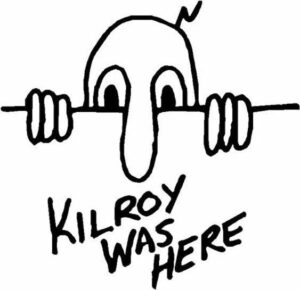 Kilroy would mark sections he had inspected with “Kilroy Was Here” to show his work. American soldiers quickly adopted this practice, and it spread like wildfire across various theaters of war. The doodle and phrase popped up on walls, vehicles, and even on enemy territory, symbolizing the omnipresence of American forces. U.S. soldiers wrote it wherever they went—on walls, ships, bridges, even battle zones. It became a kind of inside joke and morale booster. The message implied: “We were here first” or “Americans have already been here.”
Like the “Kilroy” graffiti, Trump has shown his obsession with putting his name on all possible things. A recent example is his having Florida Gov. Ron DeSantis change Palm Beach International Airport be renamed the “President Donald J. Trump International” airport.
numerous other examples are buildings and real estate like the Trump Tower in NY, Trump International Hotel & Tower Chicago, Trump International Hotel Las Vegas, & many residential towers worldwide licensed under the “Trump” name. numerous golf courses include Trump National Golf Club Los Angeles, Trump National Doral Miami Hotels & Resorts: Trump International Hotel Washington D.C., and Trump-branded hotels in New York, Chicago, Hawaii, and abroad. Consumer products (some now defunct) include Trump Steaks, Trump Vodka, Trump Ice, Trump-branded ties, shirts, mattresses, and fragrances. It includes government/Institution Renaming: The Kennedy Center was renamed the Donald J Trump Memorial Center for the Performing Arts, and the U.S. Institute of Peace became the Donald J. Trump Institute of Peace. We now have TrumpRx.gov for discounted drug purchases and “Trump Accounts.” His signature appears on U.S. paper currency, and his face is on national park passes. We also have a “Trump Class” warship and proposals to rename Dulles Airport and Penn Station with his name. The Commission of Fine Arts approved a design this month for a Commemorative 24 Karat gold coin emblazoned with the image of a stern-faced Trump.
We also have banners like the large banner depicting Trump’s face, which was hung on the Department of Justice building in Washington, D.C., in February. In August, another large banner featuring his image was hung on the Department of Labor building along a banner of President Theodore Roosevelt. Both banners read, “American Workers First.” And in June, a banner of Trump’s face was placed along one of President Abraham Lincoln on the front of the Department of Agriculture (USDA) building. Trump’s name has also been etched into another D.C. institution: the United States Institute of Peace. Months after the Trump Administration fired most of the nonprofit think tank’s board in March, the President’s name was added to it’s headquarters in early December,
TRUMP’S ATTEMPT AT INTIMIDATION
What is to be said about a President of the United States who elects to attend oral argument in the Supreme Court before judges he partially appointed and who are deciding the validity of an order he granted? Trump is the first sitting president known to have attended a Supreme Court argument. He did this after previously accusing “certain” Supreme Court justices of being “unpatriotic and disloyal” for not overturning his loss in the 2020 presidential election. Though he never said their names, his inflammatory statements were directed at Chief Justice John Roberts and Trump-appointed Justices Amy Coney Barrett and Neil Gorsuch as if they owed him a favorable ruling for having appointed them to the bench. Trump arrived about 10 minutes before the oral arguments began, accompanied by his attorney general, Pam Bondi, as well as the White House counsel, David Warrington. He sat silently in the courtroom for more than an hour as his birthright citizenship plan was debated. But about 13 minutes into the opposing argument by the American Civil Liberties Union, Mr. Trump abruptly got up and walked out, trailed by two escorts. During oral arguments, spectators are generally expected to remain seated and silent without reaction to the arguments. In all, Mr. Trump spent about an hour in the courtroom’s public gallery, listening as the justices across the ideological spectrum questioned his efforts to strictly limit birthright citizenship. The justices did not seem to acknowledge Mr. Trump’s presence, instead focusing their attention on the two lawyers presenting the case. On social media, he falsely claimed the United States was “the only Country in the World stupid enough to allow ‘Birthright’ Citizenship!” The fact is, the United States is among at least 30 countries that automatically grant citizenship to anyone born within its borders. Kate Shaw, a law professor at the University of Pennsylvania, said that given his previous insults about the justices who voted against him, “this seems like a way to send the message that justices who vote against his birthright citizenship order are in for more such attacks.”
TRUMP’S DELUSIONAL SELF-AGGRANDIZEMENT
On April 13, 2026, President Trump shared an A.I.-generated image on Truth Social depicting himself in white and red robes as a 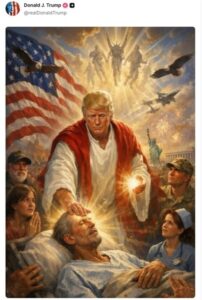 Jesus-like figure healing a person in a hospital bed. The illustration was posted without commentary, less than an hour after Mr. Trump criticized Pope Leo in another post, calling him “weak on crime” and “terrible for foreign policy.” And Trump claimed, without basis, that Leo owed his papacy to him. “He wasn’t on any list to be Pope, and was only put there by the Church because he was an American, and they thought that would be the best way to deal with President Donald J. Trump.” The pope, the first American-born pontiff to lead the world’s 1.4 billion Catholics, has spoken out against the U.S.-Israeli war with Iran, condemning the “absurd and inhuman violence” unleashed by the fighting. We’ve seen in ancient and early modern times that leaders have explicitly claimed divine status or favor: Roman emperors like Augustus were depicted as godlike figures; Egyptian pharaohs were considered literal gods, and European monarchs (like Louis XIV) promoted the “divine right of kings.” In the 20th century, the idea evolved into intense image-building: Joseph Stalin and Mao Zedong were portrayed as near-infallible. North Korean leaders like Kim Il Sung were depicted with quasi-religious reverence. No American president has taken an action like this, assuming a religious presence. Irrespective of circumstances, doing so is not defensible and is blasphemous. Worse, it raises legitimate issues about the mental functioning of this president, who apparently thinks he is Jesus.